
Repository Strategies
How you organize your source code repositories and enforce collaboration rules directly shapes how your CI/CD pipelines behave. A branching model that keeps code isolated for weeks cannot support Continuous Integration - by definition.
Branching Strategies
Section titled “Branching Strategies”Branching strategies define when to create branches, how long they should live, and how they are merged back. The goal is always the same: keep the main branch deployable at all times while enabling parallel development.
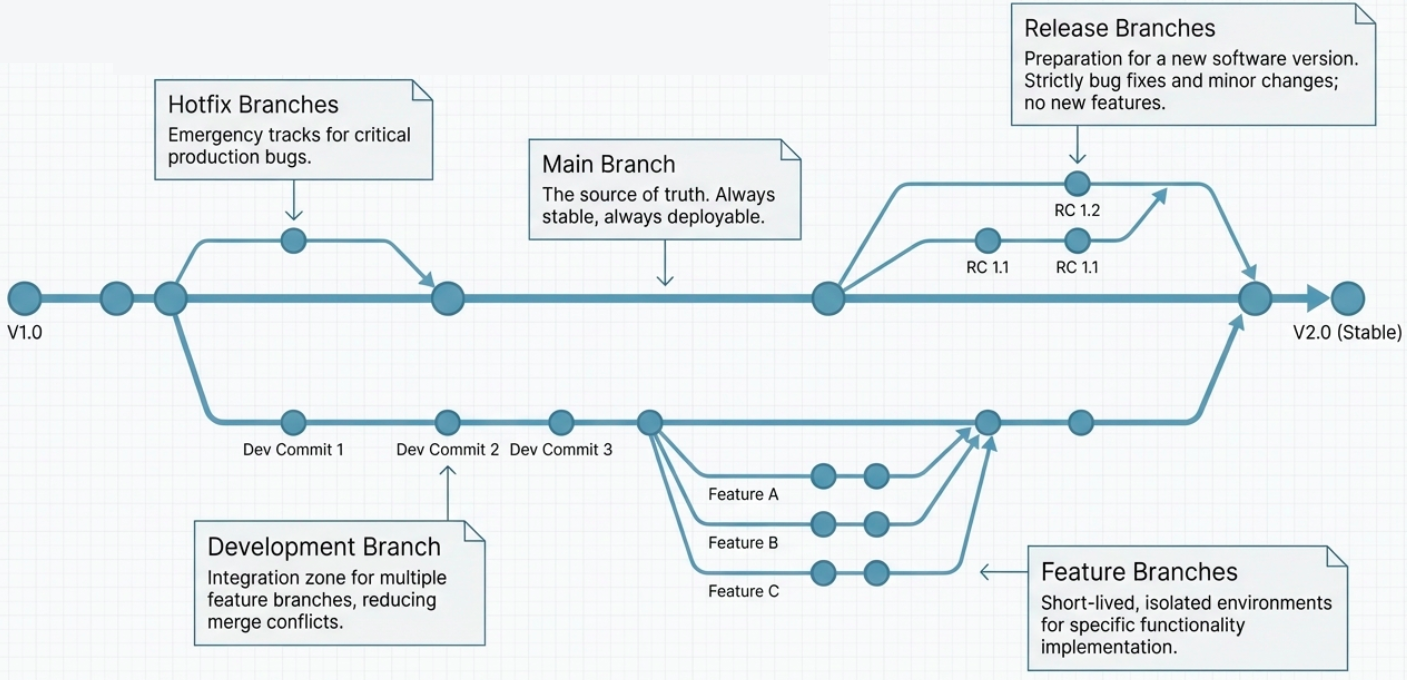
Most workflows are built from a small set of standard branch archetypes:
| Branch Type | Purpose | Lifecycle |
|---|---|---|
Main (main / master) | The single source of truth. Must always be stable and deployable. Everything branches from it and merges back to it. | Permanent |
| Feature | Isolates development of a specific feature or fix until it is complete, reviewed, and passes tests. | Short-lived (hours to a few days) |
| Release | Prepares a specific version for production. Only bug fixes allowed - never new features. Tagged with a version number on merge. | Temporary (until the release ships) |
| Hotfix | Addresses critical production bugs with urgency. Branched from the live tag on main; merged back into both main and any active develop branch. | Extremely short-lived |
| Development | Integration branch that collects multiple feature branches before they reach main. Common in legacy GitFlow. | Long-lived (if used at all) |
The Three Major Branching Workflows
Section titled “The Three Major Branching Workflows”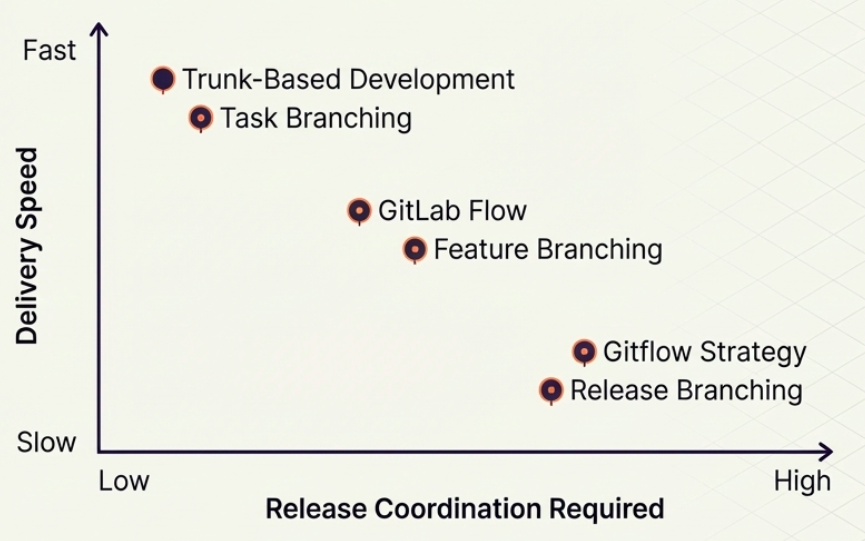
The three dominant branching workflows sit at different points on the integration spectrum - from most continuous to most structured:
| Trunk-Based Development | GitLab Flow | GitFlow | |
|---|---|---|---|
| Core idea | Integrate directly to main multiple times per day | main as working branch, with environment-named branches (Production, Preprod) | Separate develop branch + long-lived release/hotfix branches |
| Branch lifetime | Hours (or direct to trunk) | Short to medium | Days to weeks |
| Integration risk | Low - small, frequent diffs | Medium | High - large merges with conflicts |
| CI/CD compatibility | Continuous Deployment | Continuous Delivery | Continuous Delivery |
| Best for | SaaS, high-velocity teams | Teams needing environment promotion gates | Versioned products, regulated releases |
Delivery Branching Patterns
Section titled “Delivery Branching Patterns”Beyond the overall workflow, teams also layer specific delivery patterns on top. The choice should match the deployment model, not just developer preference:
| Pattern | How it works | Best paired with |
|---|---|---|
| Task branching | One short-lived branch per task, merged immediately on completion | Trunk-Based Development |
| Feature branching | Branch per feature, merged when the feature is fully ready | Microservices, GitLab Flow |
| Release (version) branching | Dedicated branch per shipped version, used to isolate fixes for that version | GitFlow, packaged software |
Monorepo vs Polyrepo
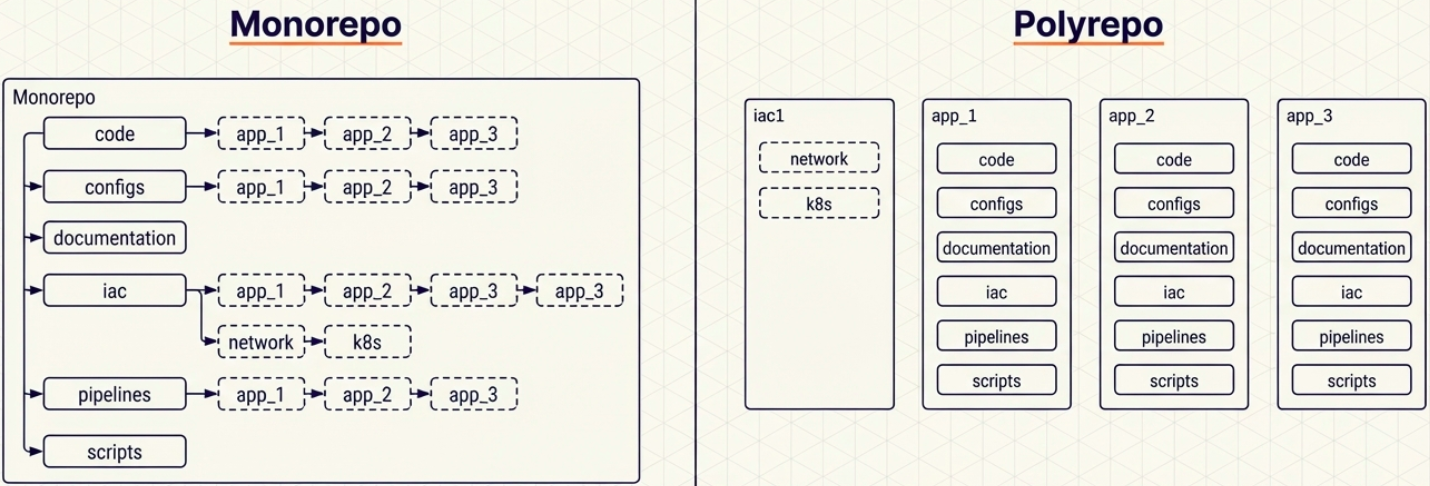
Section titled “Monorepo vs Polyrepo”The repository model you choose determines how services relate to each other, how pipelines are triggered, and how teams coordinate.
| Monorepo | Polyrepo | |
|---|---|---|
| What it is | All services and libraries live in one repository | Each service has its own independent repository |
| Atomic changes | ✅ A single commit can span multiple services | ❌ Cross-service changes require coordinated PRs |
| Pipeline complexity | High - pipelines must detect which sub-paths changed | Low - each repo has a simple, focused pipeline |
| Dependency visibility | ✅ Internal dependencies are always in sync | ❌ Version mismatches between repos cause integration pain |
| Tooling requirement | Requires Nx, Bazel, or Turborepo for change detection & caching | Standard tooling works out of the box |
| Used by | Google, Meta, Uber, Twitter | Most small-to-medium engineering teams |
The right choice depends on organizational size and team structure. Teams with many independent microservices often start with polyrepo and migrate toward monorepo as cross-service coordination overhead grows.
Microservices Repository Patterns
Section titled “Microservices Repository Patterns”Distributed microservices architectures have specific requirements. There are three common approaches, each with a different scope of isolation:
| Pattern | Structure | CI/CD implication |
|---|---|---|
| Full separation | Every microservice has its own dedicated repo and its own pipelines | Maximum independence; cross-service changes require coordinated releases |
| Separation by service type | Related services (e.g., user management, payments) share one repo | Simplifies shared database and config management; still keeps domains isolated |
| No separation (Monorepo) | All microservice code lives in a single repo | Atomic cross-service commits; requires change-detection tooling to avoid rebuilding everything on every push |