
Security & Compliance in CI/CD
Security in CI/CD is not just about scanning code - it’s about controlling who can act on pipeline resources, what those actions can produce, and proving the integrity of every artifact that reaches production. This matters especially in regulated industries, but these controls are good engineering practice for any team.
Pipeline Telemetry
Section titled “Pipeline Telemetry”Telemetry is what makes advanced deployment strategies - Canary rollouts, A/B tests, drift detection - actually work. Without measurable signals, you can’t know if a deployment is succeeding or failing.
Telemetry spans five phases of the pipeline:
| Phase | What to measure |
|---|---|
| Code | PR review time, branching frequency, code coverage, merge conflicts |
| Build | Artifact build time, dependency download duration, SBOM generation, vulnerability count |
| Test | Test suite size, failure rate, flaky test rate, test duration |
| Deploy | Pipeline execution time, deployment duration, environment provisioning time, rollback frequency |
| Post-deploy | Error rates, incident frequency, user behavior signals, live performance metrics |
Two open standards normalize this data across heterogeneous toolchains:
- CDEvents - A specification for event categories emitted across all pipeline phases (Source Code Control, CI, CD events). SDKs integrate with common build and deployment systems, ensuring signals are collected uniformly regardless of the underlying tool.
- SLSA (Supply-chain Levels for Software Artifacts) - A security-focused standard for build-phase telemetry. Covers artifact provenance and SBOM generation, allowing teams to answer “where did this artifact come from and what’s in it?”
Access and Policy Management
Section titled “Access and Policy Management”CI/CD pipelines touch production systems. Without strict access controls, a misconfigured permission or a well-meaning shortcut can bypass the safeguards your deployment strategies were designed to provide.
Segregation of Duties (SoD)
Section titled “Segregation of Duties (SoD)”SoD divides critical tasks across different individuals or systems so that no single person has end-to-end control over the pipeline. A typical SoD model:
| Role | What they can do |
|---|---|
| Developer | Commit code, open pull requests |
| QA Team | Approve builds, run test sign-off |
| Release Manager | Tag versions, approve production deployments |
| Operations Team | Monitor live environment, trigger rollbacks |
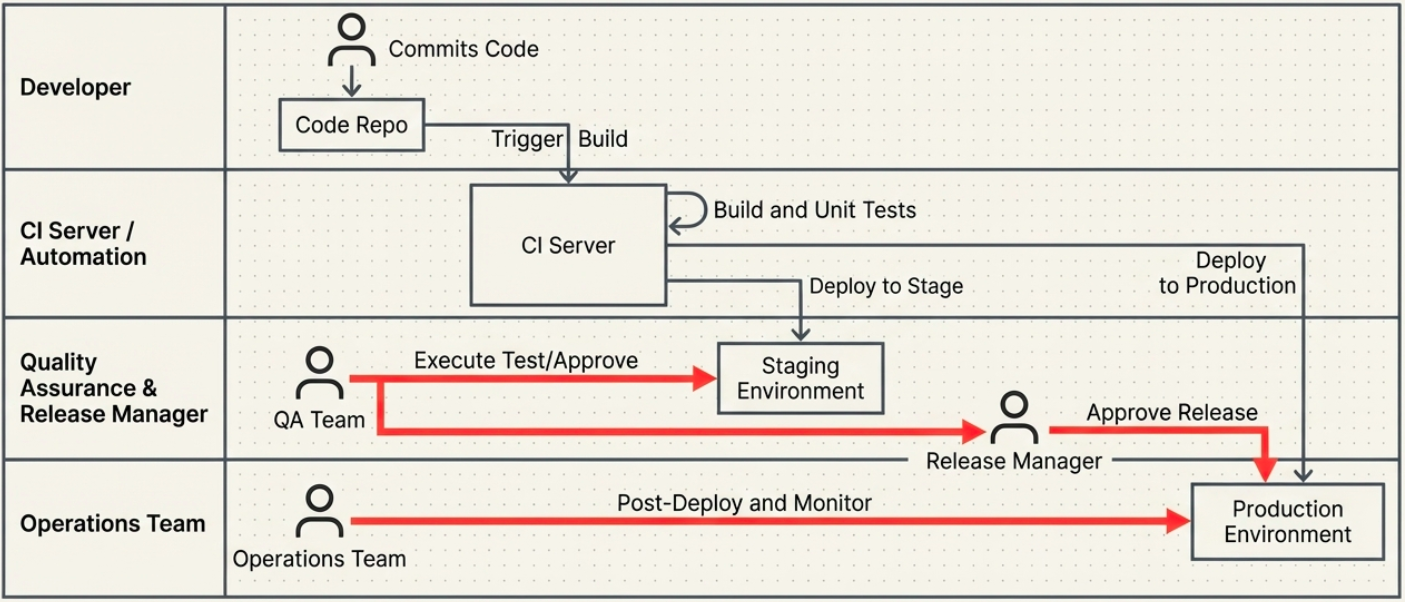
No single role crosses into another. A developer cannot approve their own PR to production; a release manager cannot modify test results.
Role-Based Access Control (RBAC)
Section titled “Role-Based Access Control (RBAC)”RBAC enforces SoD programmatically by answering: “Who can perform what actions on which resource?” Rather than managing permissions per individual, RBAC assigns permissions to roles - groups of related responsibilities - and attaches users to those roles.
A typical CI/CD RBAC hierarchy:
| Role | Their project | Other projects |
|---|---|---|
| Platform / SRE Team | Full admin - manage runners, secrets, platform config | Read access across all projects for visibility |
| Team Lead | Manage pipelines, approve deployments, configure environments | Read access to observe other teams’ pipelines |
| Developer | Trigger pipelines, update pipeline config, read logs | Read access only - cannot modify other teams’ pipelines |
Examples in practice:
- The QA team has pipeline run permissions on staging - but not production.
- Only Release Managers can approve deployment to the
mainbranch. - Developers can read pipeline logs but cannot modify environment configurations.
RBAC prevents the most common pipeline accidents: accidental production deploys and untested code bypassing staging.
Approval Flows
Section titled “Approval Flows”For high-risk actions that automated checks alone cannot validate, approval flows act as explicit human gates. Common use cases:
- Merging to a protected branch (e.g.,
release/) - Emergency hotfixes to live production
- Infrastructure changes above a defined cost threshold
Approval flows integrate directly into pipeline definitions and block execution until a designated reviewer signs off.
Open Policy Agent (OPA)
Section titled “Open Policy Agent (OPA)”Where RBAC controls who can act, OPA controls what those actions can produce. OPA is an open-source policy engine that evaluates declarative rules tied to pipeline events.
OPA can be hooked into any pipeline phase:
- Build phase: Deny a build if it violates semantic versioning schema or lacks required metadata tags.
- Deploy phase: Reject a deployment if the artifact was not signed or doesn’t have an SBOM attached.
- Infrastructure phase: Block a Terraform plan if it would expose a security group to
0.0.0.0/0.
Domain-Driven CI/CD
Section titled “Domain-Driven CI/CD”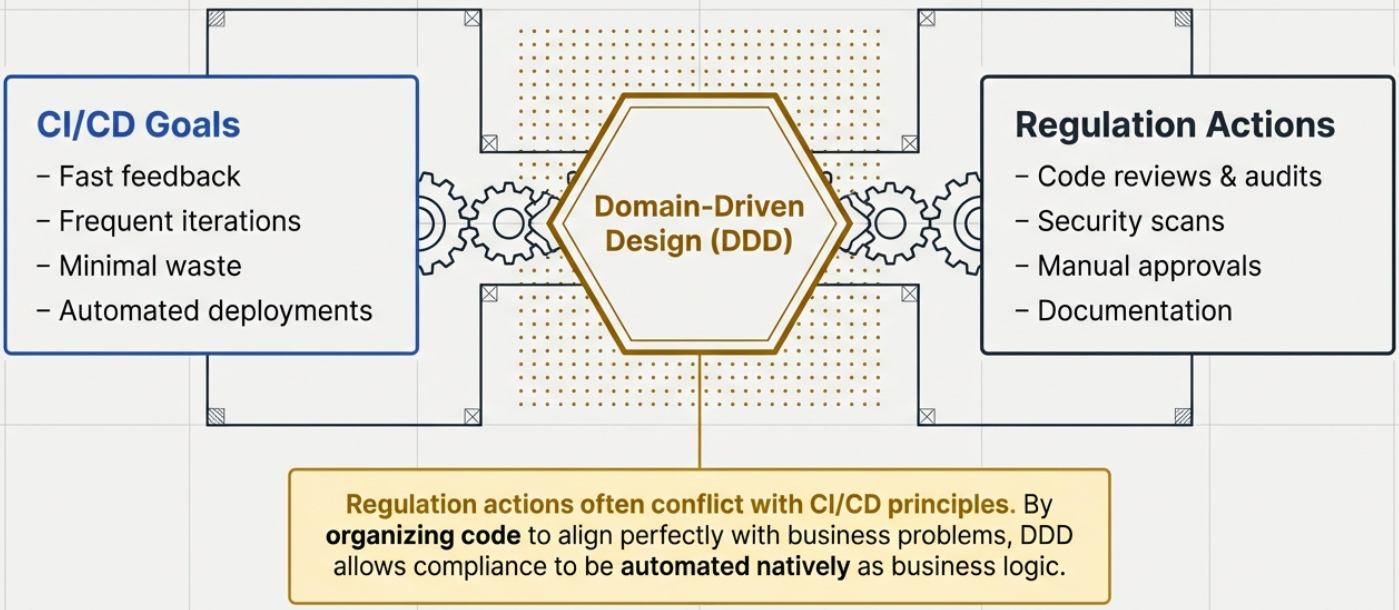
Domain-Driven Design (DDD) is a software design approach that organizes code around the actual complexity of the problem it is solving - not around technical layers. It enforces a shared vocabulary (ubiquitous language) across developers, domain experts, and stakeholders, and divides large problem spaces into clearly bounded independent areas (bounded contexts).
In a CI/CD context, DDD maps perfectly: each bounded context becomes a deployable microservice with its own pipeline, tests, and deployment lifecycle. The organizational boundary and the deployment boundary match.
The Three Layers of a Domain-Driven Pipeline
Section titled “The Three Layers of a Domain-Driven Pipeline”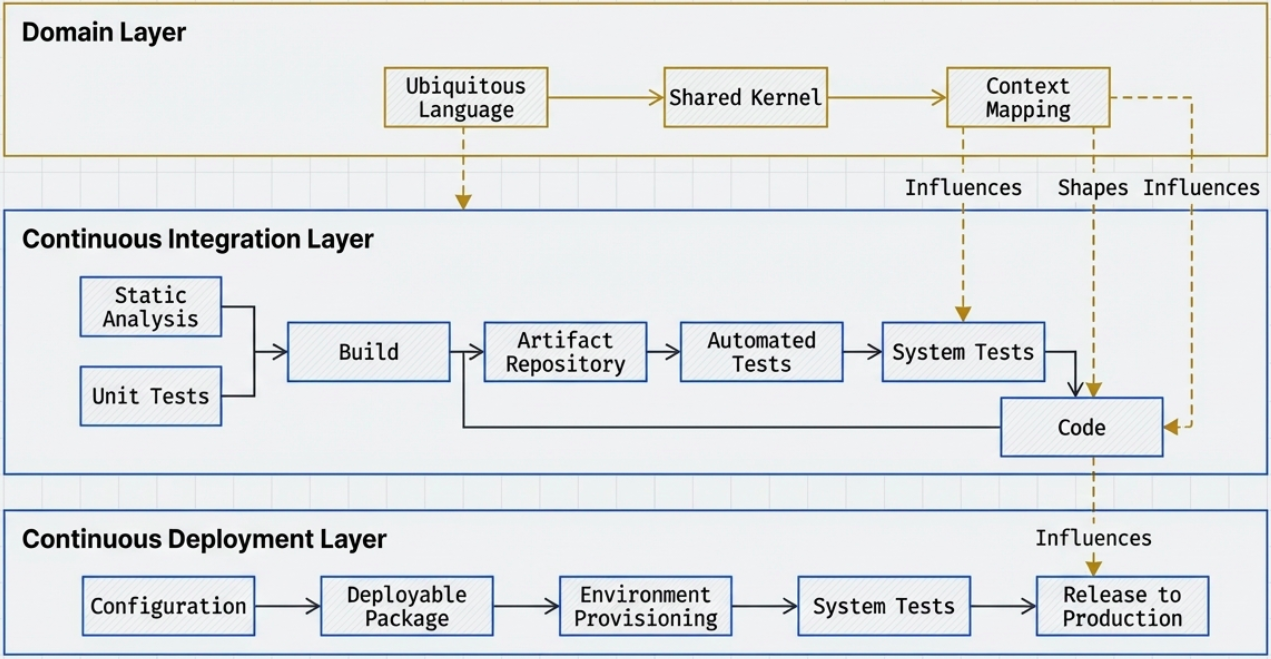
| Layer | What it covers |
|---|---|
| Domain | Core DDD concepts - ubiquitous language, bounded contexts, shared kernels, aggregates, domain events |
| CI | Static analysis, automated unit and integration tests, artifact creation |
| CD | Environment provisioning, configuration management, system testing, controlled production release |
Why DDD Improves CI/CD Outcomes
Section titled “Why DDD Improves CI/CD Outcomes”| Benefit | What it means in practice |
|---|---|
| Improved communication | Shared ubiquitous language bridges the gap between developers and domain experts - requirements are less likely to be misunderstood in code |
| Reduced coupling | Bounded contexts prevent logic from bleeding across domains, reducing the blast radius of any single change |
| Targeted scalability | CI/CD processes align with domain boundaries, so individual services scale independently without touching the broader system |
| Faster and safer delivery | CI/CD pipelines per bounded context support feature toggles, canary releases, and blue-green deployments per service, not per monolith |
| Simplified troubleshooting | When an issue occurs, the bounded context that owns it is immediately clear |
Regulation Actions in Pipelines
Section titled “Regulation Actions in Pipelines”Regulation actions - code reviews, security scans, compliance audits, mandatory approvals - are required in regulated sectors but create natural friction in CI/CD. They involve manual intervention or external verification, which conflicts with the CI/CD goal of fast, frequent delivery.
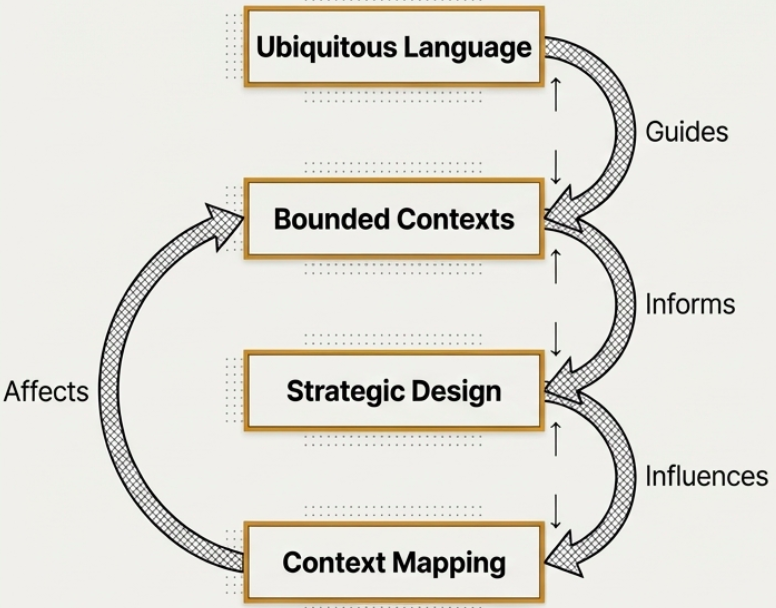
DDD offers a structured way to integrate compliance without destroying pipeline velocity, by applying five core principles:
| DDD Principle | Role in compliance |
|---|---|
| Ubiquitous Language | Regulatory requirements are named and documented in the same terms used in code and pipeline configuration - making automation of compliance checks unambiguous |
| Bounded Contexts | Regulation actions are scoped to specific contexts, avoiding system-wide compliance bottlenecks. Rigor is calibrated to the context’s actual regulatory exposure |
| Strategic Design | Categorizes the domain into core, supporting, and generic subdomains. Ensures compliance effort is proportional to business risk - avoiding over-engineering in low-risk areas |
| Context Mapping | Visualizes how compliance controls in one context interact with - or depend on - adjacent contexts. Identifies and resolves cross-boundary compliance risks |
| Domain Events | Compliance-relevant actions emit domain events that automatically trigger downstream regulatory checks. The event log becomes the audit trail |
These principles form a feedback chain: ubiquitous language shapes bounded contexts → bounded contexts inform strategic design → strategic design drives context mapping → context mapping identifies gaps that refine bounded contexts.
Access Control in Regulated Domains
Section titled “Access Control in Regulated Domains”In regulated sectors, access control is not a bolt-on feature - it is woven into the domain model itself. The domain layer owns business logic; the application layer acts as a policy enforcement point that decides what each actor is allowed to do.
RBAC vs ABAC
Section titled “RBAC vs ABAC”| Pattern | How it works | Best for |
|---|---|---|
| RBAC | Permissions are tied to organizational roles (Developer, Compliance Officer, Release Manager). Role changes update permissions automatically. | Large organizations with defined role hierarchies |
| ABAC | Permissions are evaluated dynamically against a set of attributes - user characteristics, resource type, action, and environment context (e.g., time of day, data classification). | Highly regulated domains requiring fine-grained, context-sensitive access |
Embedding Access Control into DDD Components
Section titled “Embedding Access Control into DDD Components”| DDD Component | How it enforces access |
|---|---|
| Entities and Value Objects | Access rules are part of the model itself - a PatientRecord entity knows which roles can read or modify it |
| Aggregate Roots | Act as transaction boundaries and security boundaries. All operations on an aggregate are checked before they are committed |
| Repositories | Return only the objects the caller is authorized to interact with - unauthorized data never enters memory |
| Bounded Contexts | Each context defines its own access policy, preventing unauthorized access from propagating across domain boundaries |
Building Compliant Artifacts
Section titled “Building Compliant Artifacts”Compliance belongs in the pipeline configuration, not in a spreadsheet reviewed the week before an audit. Building compliant artifacts means embedding regulatory requirements into every stage of the CI/CD process.
| Step | What to do |
|---|---|
| 1. Compliance requirements analysis | Identify the applicable regulations - GDPR, HIPAA, PCI DSS, FedRAMP. Document exactly what each mandates regarding encryption, access, logging, and data residency. |
| 2. Compliance-aware domain modeling | Design entities and aggregates with data encryption, access control, and audit logging as first-class properties - not added afterward. |
| 3. Pipeline configuration | Integrate compliance checks into the pipeline as non-negotiable gates: SAST (SonarQube), DAST (OWASP ZAP), dependency scanning, ComplianceAsCode. |
| 4. Compliance-specific automated tests | Write tests that validate encryption behavior, access control logic, and data protection rules - not just functional behavior. |
| 5. Continuous monitoring and reporting | Auto-generate audit logs and compliance reports on every pipeline run. Violations surface immediately, not at audit time. |
| 6. Deployment access controls | Enforce RBAC and mandatory approval workflows for environment promotions. No manual intervention bypasses the policy engine. |
| 7. Documentation and traceability | Maintain a clear chain from regulatory requirement → implemented feature → automated test → deployed artifact. |
| 8. Continuous adaptation | Regulations change. Build review cycles into the team’s calendar and update pipeline gates when requirements shift. |
DDD in Regulated Industries
Section titled “DDD in Regulated Industries”DDD is particularly valuable in industries where software failures have legal, financial, or safety consequences:
| Industry | DDD application |
|---|---|
| Financial services | A payment processing bounded context is completely isolated from account management and fraud detection. Domain services, aggregates, and value objects encode complex financial rules within that boundary. |
| Healthcare | Context mapping separates patient records from treatment protocols - each with its own ubiquitous language and domain events. HIPAA controls are enforced at the bounded context boundary, not scattered across the system. |
| Government / Public sector | Domain-driven structure separates license application processing from compliance checking. Strategic and tactical DDD patterns produce architectures that meet current regulatory requirements while remaining adaptable to future legislation. |
Performance Considerations
Section titled “Performance Considerations”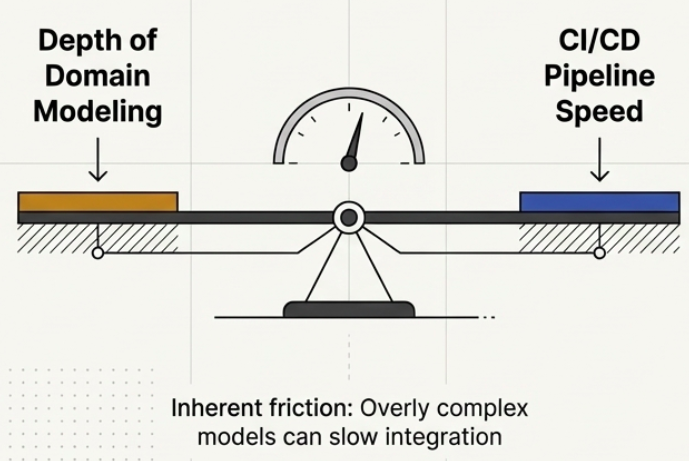
DDD adds modeling depth. CI/CD demands delivery speed. This tension is real and must be managed deliberately.
Common pitfalls:
| Pitfall | What it looks like |
|---|---|
| Overly complex domain models | Models become so granular that each integration test run takes minutes instead of seconds; the pipeline slows to a crawl |
| Underestimated learning curve | Teams struggling with DDD concepts slow down delivery and introduce inconsistencies in the bounded context boundaries |
| Communication gaps | The pace of CI/CD outstrips the pace of domain workshops; the code diverges from the current business reality |
Mitigation strategies:
- Design for modular, independently testable components - each bounded context should be testable in isolation without running the entire system
- Promote the same artifacts at every stage - no rebuilding between environments; what was tested in staging is exactly what ships to production
- Commit frequently and in small units - the feedback loop only works if the feedback arrives fast; large commits delay diagnosis
Practical Implementation Guide
Section titled “Practical Implementation Guide”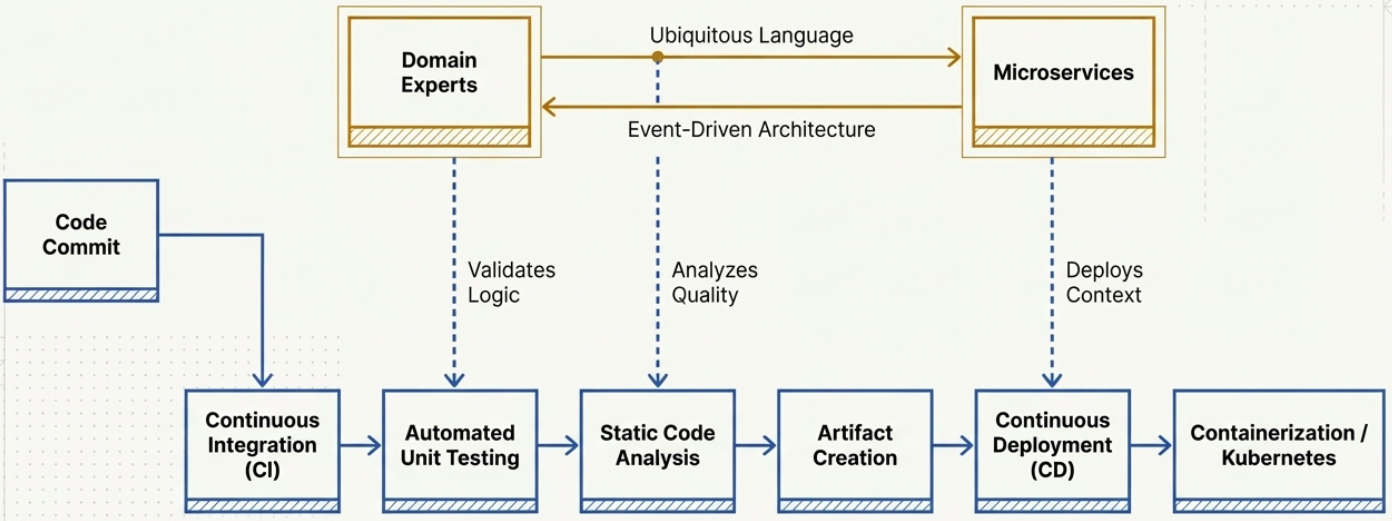
Implementing DDD in a CI/CD pipeline requires deliberate alignment between software design and business requirements:
| Step | Action |
|---|---|
| 1. Understand the domain | Work with domain experts to map business processes. Define a ubiquitous language that is reflected in variable names, event names, and test descriptions. |
| 2. Define bounded contexts | Partition the domain model into logically independent segments. Each context becomes its own deployable microservice with its own database. |
| 3. Automate domain-specific testing | Every commit triggers builds and tests. Include tests that validate business behavior - not just that the code compiles and the API returns 200. |
| 4. Use feature toggles for continuous deployment | Deploy every successfully tested artifact to staging or production. Feature toggles decouple deployment from release - new behavior ships dark until the business is ready to expose it. |
| 5. Implement observability | Track domain event flow in production. When observed behavior diverges from expected behavior, feed that back into domain model refinement. |
| 6. Build a continuous learning culture | Schedule regular domain workshops and retrospectives. The domain model is a living document - it evolves as the business evolves. |
| 7. Version control the domain model | Track changes to bounded context definitions and interface contracts alongside code. The main branch always reflects the current canonical domain model. |